
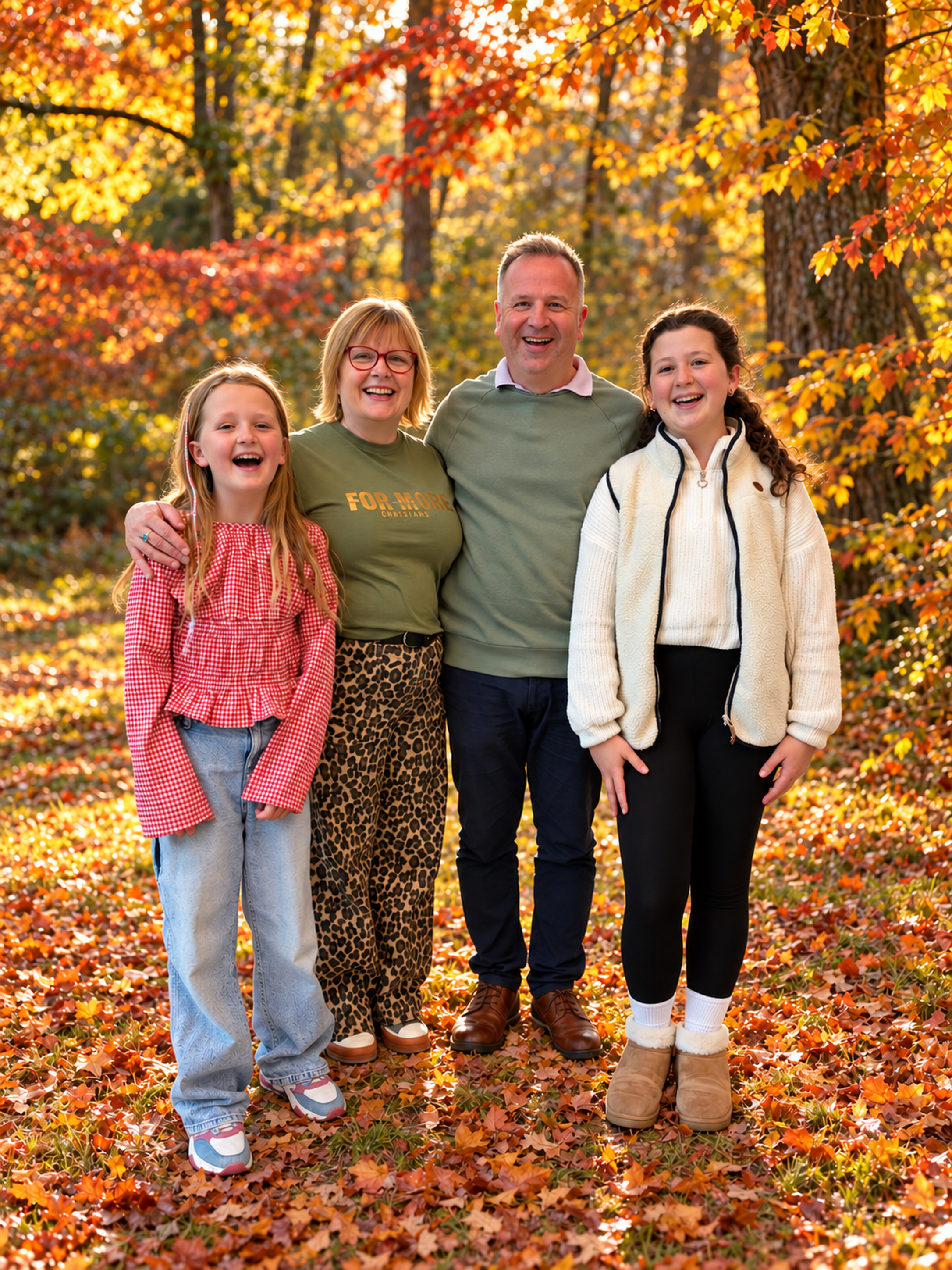
Hi. My name is Niall Fraser. I’m married to Debs, and dad to Owen, Kirsten, Eilidh and Martha. We live on the outskirts of Glasgow, Scotland. I’m one of the leaders of Easterhill Community Church. I am currently undergoing ministry training on the Crosslands Seminary programme, and have over 25 years of urban-priority (poor) area ministry experience. Over the last few years, the Lord has laid on my heart the need to find a way that allows sustainable funding of churches in the poor areas of Scotland. In this blog, I’ll briefly explain the church funding problem that exists in Scotland as well as suggest a possible investment fund solution.
In the past, many, if not most, of the churches in the poor areas of Scotland belonged to the Church of Scotland, and were heavily subsidised by the central Church organisation. In recent years, the national Church has experienced a dramatic fall in membership with a significant loss of income, which has precipitated the closure of many churches across the land particularly in the poor areas of Scotland. In the last 10 years, seven out of nine Church of Scotland churches in the Tollcross, Shettleston, Carntyne, Cranhill and Ruchazie communities in which Easterhill ministers have been shut. This process of church rationalisation is continuing to be rolled out across Scotland, with the poor disproportionately affected. With cross-subsidy of churches in the poor areas of Scotland now at an end, if churches in poor areas are to exist in the future they will have to be fully financially-independent.
Cross-subsidy no more
What’s realistic
Easterhill Community Church has its roots in a Church of Scotland congregation called St Margarets Tollcross Park, which was closed in 2016 as part of the national church’s rationalisation programme. Anticipating this possibility, from 2006 I started to put my church offering into a white envelope I kept in my sock drawer. In 2009, this money was used to set-up a charity called Tollcross Christian Fellowship (TCF), with the sole purpose of ensuring that there would be an ongoing Christian witness in Tollcross even if the Church of Scotland closed St Margarets – which they did. In 2016, TCF became Easterhill Community Church – an independent, self-financing, self-governing evangelical church. Encouragingly, the annual income at Easterhill has grown from around £20k ($28k) to £55k ($77k) between 2016 and 2026, and we now have an interest paying savings account containing ca. £100k ($140k). It’s amazing to see what the Lord has done amongst us over the years. This said, Easterhill does not have a Church building – the St Margarets building was sold off to a group of Muslims and is now a Mosque. Nor does Easterhill have any staff. Until Easterhill has both staff and a building, it’s hard to see how the church can get much bigger. For a church in a poor area, its annual income is relatively large. One of my friends who ministers in Whitlawburn (Cambuslang) has an annual budget of just £6k ($8k). If nothing changes, it’s very hard to see a long-term future for Whitlawburn Community Christian Fellowship. For me, I think that an annual income of ca. £100k ($140k) is required to run a church in Scotland that has its own pastor and building. For Easterhill, we have £50k ($70k) less than what we need to run church on a sustainable basis each year.
In the last few years, my eyes have been opened to the extent that Scottish churches are financially supported by American churches. The generosity of American brothers and sisters in Christ to those in Scotland is quite overwhelming. Having said this, I am concerned that Scottish churches may become unhealthily reliant on American money to pay their bills each year. Furthermore, I also worry that if the money that currently comes from America to Scotland were to stop for any number of reasons including donor fatigue, a significant number of churches in Scotland (especially those that have been planted in recent years) would become unviable overnight!
So, is there a way that money could be put into Scottish churches in such a way as to ensure a long-term viable church that does not depend on long-term external support? I believe that an investment approach to funding Scottish churches could be transformative especially for those located in poorer areas. Recently, Debs’ mum and dad have passed onto glory. In their last years, the house they lived in was sold, and the money invested professionally. The dividend income from the money invested was sufficient to pay the rent of the sheltered housing they stayed in until the Lord called them home. The capital was not used to pay bills, increased in value over time, and became the children’s inheritance. Having experienced the success of this investment approach to care for my parents-in-law, it made me wonder if such an approach could be used to fund churches in the poor areas of Scotland. So, I started doing some sums…..
If the annual funding gap for a poor church in Scotland is £50k per year, and an annual dividend rate of 5% could be achieved, the size of the investment fund required to fund a church sustainably would be £1,000,000 ($1,400,000). Ouch. Suddenly, what initially looked like a good idea seemed absurd. But then I did some further sums. If 1,000 people committed to giving £28 ($40) per month for 3 years, an initial investment amount of £1,000,000 could be realised. Suddenly, my idea sounded feasible but only if a large support network of donors could be assembled who were prepared to give monthly for a time-limited period. Although a lot of money would be required upfront to establish an investment fund sufficiently large to make a church in a poor area financially viable, this funding strategy would ensure that these churches:
Addressing the funding gap
Are you a glass half full or a glass half empty kind of person? Do you think that the demise of the Church of Scotland is bad or good news for the people of Scotland who live in poor areas? Personally, I think it is good news, for the future of the church in Scotland’s poor areas is likely to be independent evangelical churches like Easterhill. That is, if a way can be found to address what I call “the £50k funding problem”, which is the annual difference between what a healthy gospel church in a poor area should be able to raise themselves and the actual cost of running a church that has a building and at least one member of staff. A financial gap of £50k ($70k) per year per church is significant. Where could the money come from?
had sufficient funds to employ an evangelical pastor and maintain a building indefinitely
could flourish through outreach and community activities that will, in time, generate future funds through increased giving to the church by new converts
are primed for planting other churches through having access to an increasing amount of capital
are future-proofed against inflation-related price increases
How could you get involved?
Advancing an investment approach to financing churches in the poor areas of Scotland is what the Lord has laid on my heart. I’ve decided to call the initiative Transform Scotland. The only way I will ever know if this idea is of the Lord, and not of Niall, is to put my vision out there and see what people think. So, writing this blogpost is a big first step of faith for me. Transform Scotland will only come to pass if other people come on board with my idea, which currently is at an early stage of development. To help shape my thinking, I’d be really grateful to receive your feedback on what I’ve written here. So can I ask:
do you think that an investment fund approach could help deliver sustainable, growing churches in the poor areas of Scotland? Why or why not?
would you consider personally giving to or become an ambassador (someone prepared to explain the vision to others) for Transform Scotland?
do you have any alternative suggestions as to how the annual funding gap might be bridged?
do you have (or do you know anyone with) relevant financial expertise that could help establish and manage an investment fund?
would you commit to praying for churches in the poor areas of Scotland, that ways might be found to enable sustainable and growing churches to be established
As plans develop, if you would like to hear more about Transform Scotland, please can you click the Subscribe button which will take you to a Google form where you can provide me with your name and E. mail address. Even at this very early stage, if you were willing to be either a donor or an ambassador in the future, please could you tick the appropriate box on the Google form. Last, please feel free to send me an Email (nialljfraser@icloud.com) with your thoughts and comments on Transform Scotland - they would be gratefully received, and useful for shaping my next steps.
Thanks so much for taking the time to read this blog. I’m so grateful for your loving interest.
Your brother in Christ, Niall